What is coherent water?
Water as a medium for transmitting information
Water is more than it seems
We all know water. We drink it every day and see it all around us. Yet water is less simple than it seems.
Most of the time we think of water in three forms: Ice, liquid water and steam.
But scientists are discovering that there may be a fourth form: a more structured, gel-like form of water.
This form is mainly found in living organisms, for example around our cells. This provides new insights: Water may not just be a “means of transportation”, but plays an active role in how our bodies function.
When water takes on this ordered structure, its behavior also changes.
Some scientific theories describe that water in this state can store and pass on information – comparable to a hard drive, but on a molecular level.
Since our bodies are largely made up of water, this could mean that water plays a role in how cells, tissues and systems communicate with each other.
Water with its own rhythm
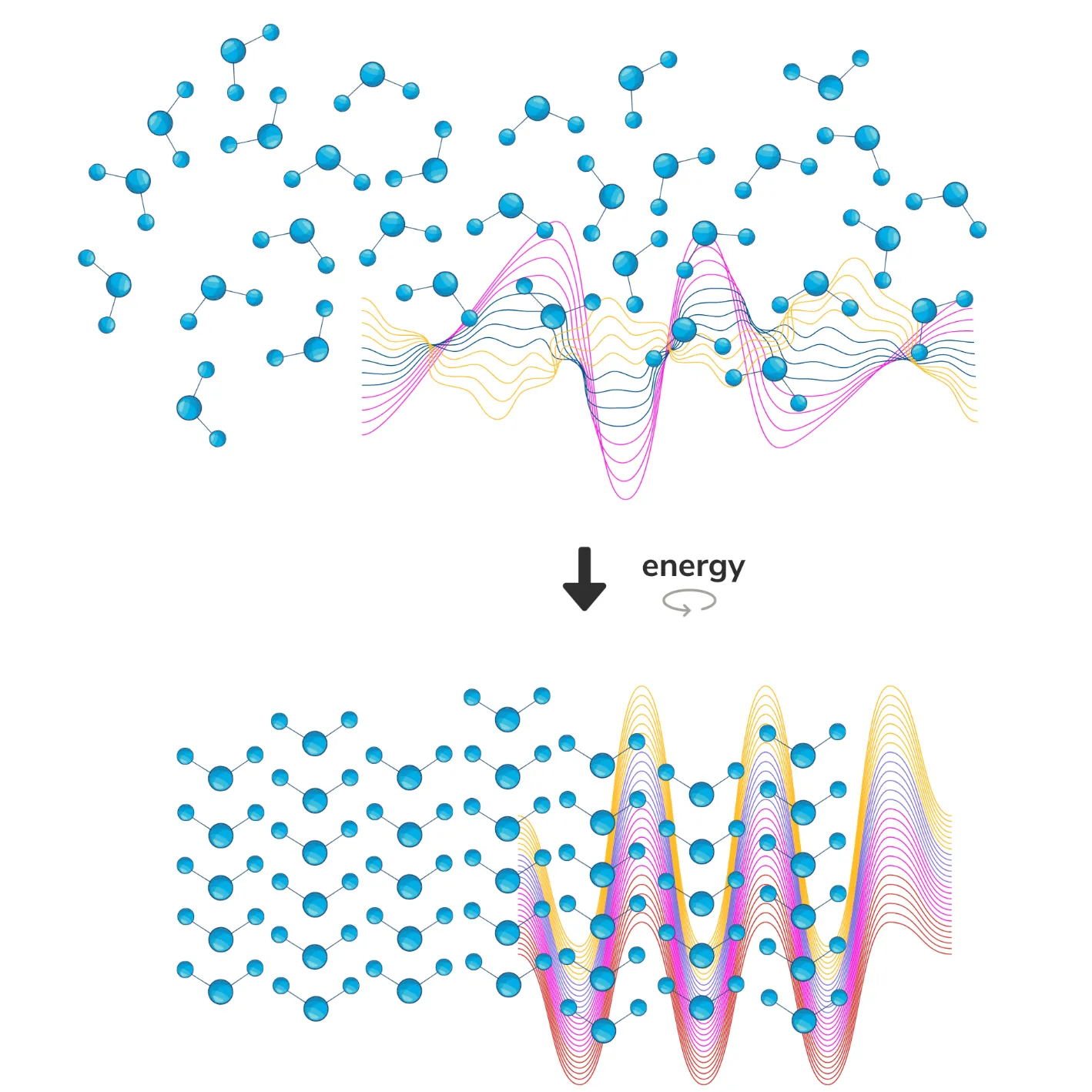
At the smallest level, water molecules are constantly in motion. Normally, they move fairly randomly.
However, under certain circumstances, these molecules can coordinate with each other. They then no longer move chaotically, but in a kind of common rhythm.
It can be compared to:
People talking in confusion (chaos)
versus an orchestra making music together (harmony)
When water behaves in this way, we speak of a coherent state: a more ordered and stable form of water.
We consist of 99% water – and that has a big impact!
Our body consists to a large extent of water. What’s more, the majority of the molecules in our body are made of water. It surrounds important building blocks such as proteins and DNA and fills all the small spaces in between.
This means that the way water behaves can affect how our bodies function.
Under certain circumstances, it can organize itself into a coherent structure. This opens up new insights into the possible role of water in the body – not only as a carrier of substances, but also as a carrier of information.
In this role, water is not only “present”, but possibly also actively involved. The structure of water can influence how these biological systems function and communicate with each other.
According to this theory, water in and around our cells can:
– organize itself
– pass on information
– and support processes in the body
“Water is the matter and the matrix of life, mother and medium. Without water there is no life.”
Water is often thought of as a simple chemical compound: H₂O. In reality, however, water behaves like a dynamic system, constantly changing under the influence of its environment.
In nature, water is almost never still: it flows through rivers, it evaporates and condenses, and it is exposed to light, temperature variations, and electromagnetic influences. All these factors affect how water structures itself.
Some scientific findings suggest that under certain circumstances, water can even assume a more structured, gel-like form, particularly in and around living cells.

The effects on biology
Normally, water molecules move randomly. Under certain circumstances, however, they can coordinate with each other and move in a common rhythm.
From a biological perspective, this takes on added significance. The human body is largely made up of water – not just in terms of volume, but in fact around 99% of all molecules.
According to the theory of coherent water, the structure of water changes when it is in and around living cells. The water becomes more organized and forms a medium in which information can be passed efficiently between cells, tissues and organs.
Water is present throughout our bodies.
It surrounds essential building blocks like proteins and DNA and fills the spaces between them. In this environment, water is not just a transport medium, but forms the very foundation upon which everything else is built.
The structure of water can therefore influence: the functioning of biomolecules, communication between cells, and the balance of systems.
“Water is the matter and the matrix of life, mother and medium. Without water there is no life.”